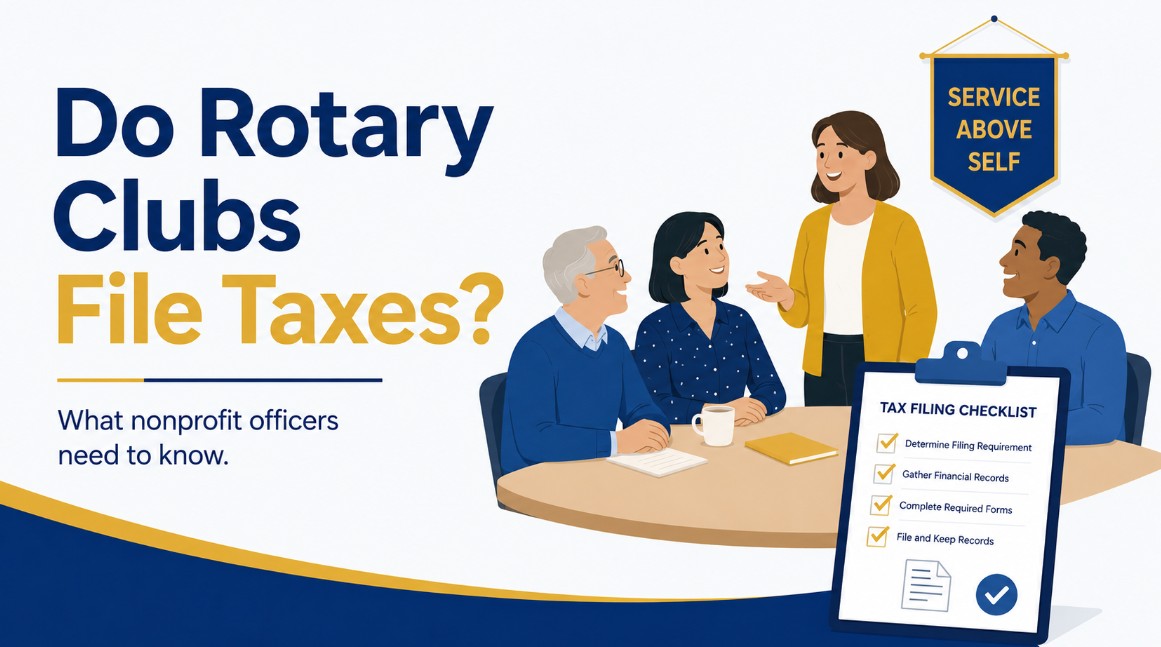
How to File Rotary Club Taxes
Most Rotary clubs must file an annual Form 990-series return with the IRS, even if the club is tax-exempt and does not owe federal income tax.
The form your club needs generally depends on its annual gross receipts and total assets.
Which Form Does a Rotary Club File?
A Rotary club with gross receipts normally of $50,000 or less can generally file Form 990-N, also known as the e-Postcard.
A club with gross receipts under $200,000 and total assets under $500,000 can generally file Form 990-EZ.
A club with gross receipts of $200,000 or more, or total assets of $500,000 or more, will generally need to file the full Form 990.
Some clubs may also need to file Form 990-T if they receive taxable income from business activities that are unrelated to their exempt purpose.
Do Rotary Clubs Have to File Taxes?
Yes! Most Rotary clubs must submit an annual filing to the IRS.
Being tax-exempt does not mean the club is exempt from filing. A Rotary club may not owe federal income tax, but it still generally must report its activities each year.
Rotary Club Versus Rotary Foundation
A Rotary club and a related Rotary foundation may be separate legal organizations.
They may have different EINs, bank accounts, tax-exempt classifications, and filing requirements.
If the club and foundation have separate EINs, they will generally need to maintain separate financial records and complete separate IRS filings.
Do not combine the finances of a Rotary club and its foundation simply because they share officers, branding, or community projects.
When Are Rotary Club Taxes Due?
A Rotary club’s Form 990 filing is generally due on the 15th day of the fifth month after the end of its tax year.
For example:
- A club with a December 31 year-end generally files by May 15.
- A club with a June 30 year-end generally files by November 15.
- A club with a September 30 year-end generally files by February 15.
If the deadline falls on a weekend or federal holiday, the filing is generally due on the next business day.
Organizations filing Form 990 or Form 990-EZ can usually request a six-month extension. Form 990-N cannot be extended.
How to File Rotary Club Taxes
1. Find the Club’s EIN
Locate the EIN assigned specifically to the Rotary club.
It may appear on previous Form 990 filings, IRS letters, bank records, or older tax documents.
Do not use the EIN belonging to Rotary International, the Rotary district, a related foundation, or an individual officer.
2. Review the Club’s Filing History
Check the club’s previous filings before starting a new return.
This will help you confirm:
- Which form the club filed last year
- The club’s correct tax year
- Whether any filing years are missing
- Whether its tax-exempt status remains active
Pro990 allows Rotary club officers to review their organization’s available filing history and download PDF copies of previous filings in one place. Simply enter your EIN in the tool below to see what your organization has filed within the last 3 years.
3. Calculate Gross Receipts
Gross receipts generally include all money received by the club before expenses are deducted.
This may include:
- Membership dues
- Fundraising proceeds
- Sponsorship payments
- Donations
- Grants
- Event revenue
- Interest income
Do not use the club’s net profit when deciding which form to file.
For example, if a fundraising event brings in $60,000 and costs $40,000 to operate, the club’s gross receipts from the event are still $60,000.
4. Select the Correct Form
Use the club’s gross receipts and total assets to determine whether it qualifies for Form 990-N, Form 990-EZ, or Form 990.
Reviewing the club’s previous filing can provide a helpful starting point, but you should still confirm that the club meets the requirements for the current tax year.
5. Complete and Submit the Filing
Enter the club’s information into the appropriate form-type for your organization based on tax-exempt status and revenue.
Review the return before submitting it and save the IRS acceptance confirmation and a PDF copy of the filing.
What Happens If a Rotary Club Does Not File?
A tax-exempt organization that fails to file a required Form 990-series return for three consecutive years will generally have its federal tax-exempt status automatically revoked.
Losing tax-exempt status can lead to:
- Federal tax obligations
- Grant application problems
- State compliance issues
- Banking complications
- Reinstatement expenses
- Questions from members and donors
New Rotary club treasurers should always review the club’s filing history rather than assuming previous officers completed every required return.
Common Rotary Club Filing Mistakes
Common mistakes include:
- Using the wrong EIN
- Confusing the Rotary club with its foundation
- Reporting net income instead of gross receipts
- Assuming the district files for the club
- Missing a deadline during an officer transition
- Believing that tax-exempt organizations do not have to file
Keeping copies of previous returns and IRS acceptance confirmations can make future leadership transitions much easier.
File Your Rotary Club’s Form 990
Most Rotary clubs must file Form 990-N, Form 990-EZ, or Form 990 each year.
Start by confirming the club’s EIN, reviewing its filing history, calculating its gross receipts, and selecting the correct form.
Visit Pro990.org to check your Rotary club’s filing history, download available PDF copies of previous filings, and begin a Form 990-N or Form 990-EZ filing.
Review your club’s records and file on time to help protect its tax-exempt status.
This article provides general educational information and is not legal or tax advice. Rotary clubs with complex finances, uncertain tax-exempt status, or unrelated business income should consult a qualified tax professional. Always check with a representative of the Rotary Club to ensure you are using the right E-file provider when submitting your returns.